Presentation gives insight to cancer trends in Monona County
Published 6:39 pm Tuesday, October 20, 2026
A presentation hosted on October 8 by Mary Charlton, PhD, professor in the University of Iowa Department of Epidemiology and director of the Iowa Cancer Registry, and Audrey Gronemeyer, MPH, research specialist with the Iowa Cancer Registry gave insight to the latest cancer data in Monona County.
This presentation was part of the Cancer in Iowa: 99 Counties Project, a statewide public health initiative focused on increasing cancer education and community engagement across all 99 Iowa counties.
Iowa currently has the second-highest rate of new cancer diagnoses in the United States and the 23rd high test rate of cancer deaths in the United States. The 99 Counties Project gives communities an opportunity to better understand what cancer looks like locally. The goal is to enhance community engagement and education around cancer prevention and control across all of Iowa’s 99 counties.
“Awareness is important because it leads to people getting tested more,” said Debie Lahr with Burgess Public Health. “Or if you’re not aware of all of the possibilities, then you’re not going to ask questions about it.”
By raising awareness, when people go for their appointments, they can ask their doctors about different screenings and that adds more prevention.
Cancer is complicated as there is no one cause of cancer. It is a combination of different genetic, lifestyles, and environmental risk factors that change the function of cells.
Risk factors are things that increase your chances of getting cancer like tobacco, alcohol, unhealthy diet, not being physically active or sunburns. Genetic factors are your family history of cancer and random mutations. Environmental factors are exposure to chemicals or radiation.
“The Iowa Cancer Registry (ICR) along with other population—based cancer registries, do not collect data on environmental risk factors, but we do share our data with researchers to support studies of cancer and environmental risk factors,” Charlton explained.
Lahr said, right now Monona County is participating in “Combat Cancer” through Marion County as they received a grant for the entire state. Through the program, there are free radon testing kits available at Monona County Environmental Health. Homeowners in Monona County have access to a free radon kit. Lahr said with that, there’s an opportunity to apply for some financial assistance for radon mitigation.
There’s also more things coming out with “Combat Cancer” that haven’t implemented yet.
Those attending the presentation asked a lot of questions and the 99 Counties project presenters took the time to answer their questions and discuss things further.
Each year, there are about 75 new cancer diagnosis in Monona County.* This incidence rate is higher than the US average and is ranked eight out of 99 counties. Each year, there are about 26 cancer deaths in Monona County.** The rate is similar to the national average and ranks #34 of 99 Iowa counties.
Both the cancer incidence rates and mortality rates are typically higher in men than women.
According to Iowa Cancer Registry data, the five most commonly diagnosed cancers in Monona County are:
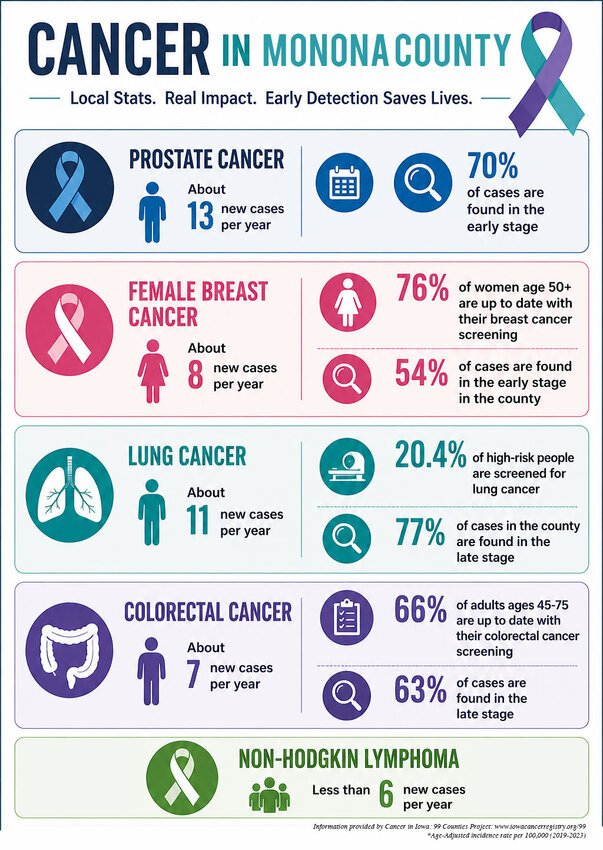
Prostate Cancer — 171.7 cases per 100,000. The age-adjusted incidence rate is statistically similar to Iowa’s rate of 133.4 but statistically higher than the national rate of 119.9. Each year in Monona, there are about 13 new cases per year. 70% of cases are found in the early stage
Screening Guidelines for Prostate Cancer: Prostate-specific antigen (PSA) blood test; Men who are 55-69 years old, discuss with your doctor if a PSA test is right for you
Female Breast Cancer — 115.2 cases per 100,000, statistically similar to both Iowa and national rates. Each year in Monona, there are about 8 new cases per year. 76% of women age 50+ are up to date with their breast cancer screening as 54% of cases are found in the early stage in the county.
Screening Guidelines for Breast Cancer: Women ages 40-74 should screen with a mammogram every 2 years; Talk to your doctor if you have a family history of breast cancer
Lung Cancer — 74.5 cases per 100,000. The rate is statistically similar to Iowa’s rate of 59.6 but statistically higher than the national rate of 51.8. Each year in Monona, there are about 11 new cases per year. 77% of cases in the county are found in the late stage.
Screening Guidelines for Lung Cancer: Low-dose CT scan; If you have smoked in the last 15 years and are between the ages 50-80 years talk to your doctor about being screened for lung cancer; Risk Factors: Smoking is #1 cause of lung cancer and Radon is #2 leading cause of lung cancer Test your home for radon and mitigate
Colorectal Cancer — 45.4 cases per 100,000, statistically similar to both Iowa and national rates. Each year in Monona, there are about seven new cases per year. 66% of adults ages 45-75 are up to date with their colorectal cancer screening. In the county 63% of cases are found in the late stage.
Screening Guidelines for Colorectal Cancer: Adults ages 45-75 can screen with either (1) an at-home, stool-based test, or (2) a colonoscopy.
Non-Hodgkin lymphoma — 30.4 cases per 100,000, statistically similar to both Iowa and national rates. There are less than six new cases per year in Monona each year.
Forty percent of cancers in the United State are attributable to modifiable risk factors (smoking, alcohol, diet, infections, etc).
Here is a list of how you can reduce your risk for cancer:
Do not smoke or use any form of tobacco. Make you home smoke-free
Limit alcohol consumption
Reduce indoor and outdoor air pollution (including radon)
Enjoy a health diet
Be physically active
Decrease excess body weight
Avoid too much sun, use sun protection
Vaccinate against Hepatitis B & HPV
Get the appropriate cancer screenings for you
The Iowa Cancer Plan identifies several strategies that can help reduce Iowa’s cancer burden, including tobacco prevention and smoking cessation, radon mitigation, sun protection and skin cancer prevention, reducing excessive alcohol consumption, and increasing access to nutritious foods and opportunities for physical activity.
Lahr said, “I would just encourage anyone to talk to their provider about different testings and screenings and always stay up to date on the recommended screening.”
For more information about the Cancer in Iowa: 99 Counties Project visit: www.iowacancerregistry.org/99
Early stage = Easier to treat, Higher survival rates
*Age-Adjusted incidence rate per 100,000 (2019-2023)
**Age-Adjusted mortality rate per 100,000 (2020-2024)